


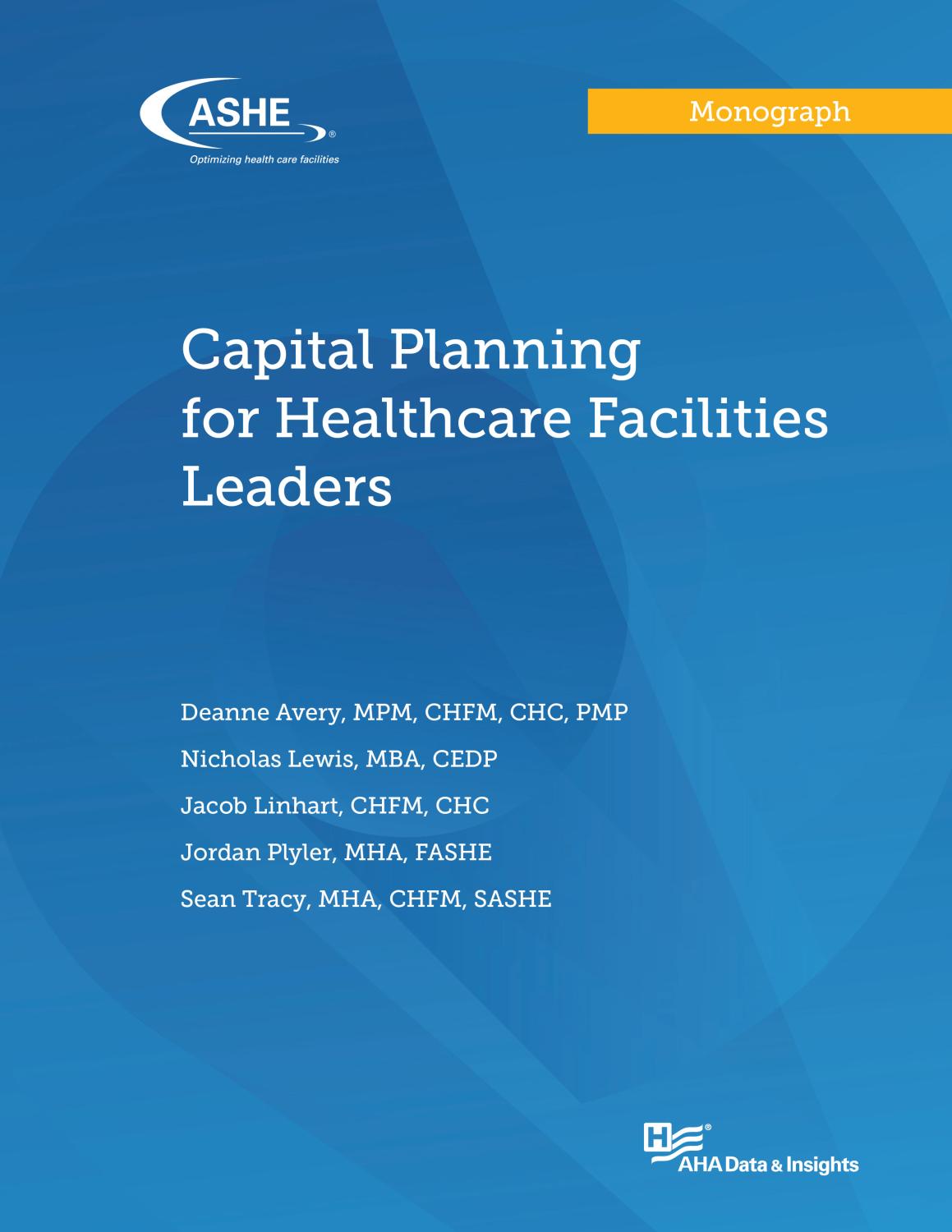
Capital Planning for Healthcare Facilities Leaders
This monograph equips healthcare facilities leaders with perspectives, tools and strategies to embrace capital planning as both a core responsibility of healthcare facilities leadership and a key component of operationalizing a healthcare organization’s mission and strategy.
Authors: Deanne Avery, MPM, CHFM, CHC, PMP; Jacob Linhart, CHFM, CHC; Jordan Plyler, MHA, FASHE; Nicholas Lewis, MBA, CEDP; Sean Tracy, MHA, CHMF, SASHE
Get the monograph
| Format | Catalog number | Price |
|---|---|---|
| Download digital version | P055170 | Member Free Nonmember $35.00 |
| Order print version | 055170 | Member $25.00 Nonmember $35.00 |
Capital Planning for Healthcare Facilities Leaders Overview
See how the monograph helps facilities leaders prioritize infrastructure needs and make the case for capital investment, as explained by the authors.
What’s included
- The Facilities Leader’s Role in Capital Planning
- The Five W’s: Understanding an Organization’s Unique Capital Planning Process
- Aligning Facilities Department Needs with Organizational Investment
- Strategic Capital Planning and Equipment Management in Practice
- Facilities Leadership in Organizational Capital Planning
Appendices
- Alternative Capital Funding Sources
- Capital Request Illustrative Case Narrative
- Practical Tools: Templates, Prompts and Checklist
Extended Overview
Capital planning in healthcare facilities management is more than a technical exercise. Done well, it is a leadership function that directly affects reliability, continuity of care and the organization’s financial footing. With healthcare systems facing heavy operational pressure, aging infrastructure and limited capital dollars, the facilities manager’s job now extends well beyond keeping buildings and equipment running. The modern facilities leader has to think strategically, communicate clearly and advocate effectively, turning day to day realities into business cases that stand up in the boardroom.
Fortunately, facilities managers are experts in the domain of the healthcare physical environment. They understand the equipment, infrastructure and systems that support effective care delivery better than anyone else in the healthcare facility. This places them in a strong position to both advocate for capital for their teams and guide the organization's long-range view for capital projects. With the right skills — and the right mindset — facilities leaders can not only succeed in securing support for investment in the physical environment; they can enable more effective financial stewardship for the entire healthcare organization.
Want more? Check out the Optimizing Health Care Finance: The Facilities Manager's Handbook.
Capital Planning FAQ
Why is capital planning an essential skill for healthcare facilities leaders?
Healthcare facilities managers are often experts at addressing routine operational demands like completing emergency repairs, conducting equipment inspections, addressing staffing gaps and coordinating with vendors. While these are essential functions of the healthcare facilities manager role, healthcare organizations cannot absorb endless deferred maintenance tasks without consequences.
When equipment fails unexpectedly, the downstream costs, revenue disruption, overtime labor expenses, patient impact and reputational damage often dwarf the cost of a planned replacement. It is the facilities manager’s responsibility to surface those consequences plainly, document the risk of waiting and show the value of investing before the failure happens. The healthcare facilities manager’s participation in capital planning benefits equipment reliability, which in turn contributes to continuity of care.
Seen through that lens, the facilities manager practices responsible financial stewardship by advising on risk, aligning infrastructure choices with long-term strategic goals and helping the organization avoid preventable surprises.
What unique perspective can facilities leaders bring to capital planning?
Facilities leaders hold a unique and often underappreciated position within healthcare organizations. Years of experience give facilities managers an intimate familiarity with the building and its internal systems. They know the facility’s real-world operational constraints and their inherent risks, including how systems were designed and how they perform under pressure.
In this way, facilities managers hold the “home-team advantage” in the healthcare physical environment. Their combination of technical proficiency and operational perspective helps inform long-term planning, contribute to capital prioritization discussions and influence decisions that affect a healthcare organization’s resilience, regulatory compliance, safety and strategic growth.
How can facilities leaders better understand their organization’s capital planning process?
Each healthcare organization’s capital planning process varies based on its structure, size, governance and access to funding. Healthcare facilities managers should consult their organization’s resources and ask questions to understand how capital planning works for their hospital or healthcare system.
Questions to ask include the following.
- Why is the organization’s capital plan set up the way it is?
- How does the organization distinguish capital expenses from operational expenses?
- Who are the key participants and decision-makers, such as finance leaders, executive leadership and clinical service line leaders?
- How does the healthcare facilities department intersect with other organizational processes and service lines, and what implications does that have for capital planning?
- When does the organization’s capital planning cycle take place?
How should facilities leaders assess and prioritize competing infrastructure needs?
Healthcare facilities managers have several resources at their disposal to evaluate the condition of a facility’s equipment and systems. These tools can help managers prioritize investments by considering equipment condition, useful life, operational risk and strategic alignment.
Assessment resources include the following.
- The American Hospital Association’s Estimated Useful Lives of Depreciable Hospital Assets guide offers a benchmark for comparing the age of common equipment with its expected useful life.
- ASHE’s Useful Service Life (USL) Assessment Tool helps users document the condition of the building and its components by ranking items on a scale of 1 to 5. Browse ASHE resources.
- The facility condition index (FCI) helps a facilities manager assess whether to repair or replace an asset. To calculate it, divide the cost of repair by the cost of replacement and express the result as a percentage.
How can facilities leaders make a stronger case for capital funding?
Healthcare facilities leaders sit at the intersection of safety, reliability, fiscal stewardship and organizational mission. Capital decisions help protect services, safeguard people and manage risk in a way executive leadership can understand and support.
Facilities leaders should treat capital planning as an ongoing strategic discipline. A repeatable process gives decision-makers clear options, helps avoid larger costs and risks, and builds credibility from one capital cycle to the next.
Healthcare facilities managers can build their case by gathering concrete facts and data, then presenting that information in terms that matter to decision-makers. Explain what asset age and condition, maintenance and service history, and downtime mean for risk, cost, strategy and the organization’s operations.