


Price Transparency Legislative Activity: Summary and AHA Recommendations
 Overview
Congress is currently advancing several bills that would legislate federal price transparency requirements for hospitals, clinical laboratories, imaging centers, ambulatory surgery centers and health plans. The AHA supports transparency that helps patients access meaningful, actionable cost information, and has offered constructive feedback to the House and Senate Committees to help ensure these bills achieve that goal as effectively as possible.
House Ways and Means Committee
On July 15, 2026, the committee marked up the Health Care Price Certainty for All Americans Act (H.R. 9645), which passed 25-15.
The bill would codify price transparency requirements for hospitals and health plans, as well as clinical laboratories, imaging centers and ambulatory surgery centers; require hospitals to post cash prices in the hospital; increase penalties for hospital noncompliance; and adjust how hospitals may use price estimator tools to meet existing transparency requirements.
AHA’s comments on the bill are available in this statement.
AHA Recommendations:
Posting prices: The AHA supports efforts to give patients meaningful price information and encourages the committee to consider other tools, since physically posting in a hospital setting the discounted cash prices or the median self-pay cash price from the past three years may offer limited value for emergency patients and may not be accessible to scheduled patients in time to inform their choices before arriving at a facility for care.
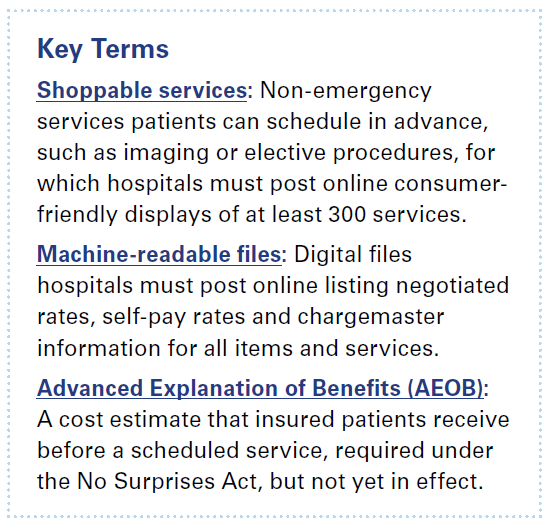
Price estimator tools: The AHA asks the committee to preserve hospitals’ ability to use price estimator tools to satisfy the shoppable services requirement even after the AEOBs take effect, given how consumer-friendly these tools have proven for helping patients estimate out-of-pocket costs.
Hospital oversight: The AHA encourages the committee to consider whether a five-fold increase in the maximum hospital penalty (from $2 million to $10 million) is necessary, given that thousands of CMS reviews have already resulted in strong hospital compliance, with few penalties imposed.
Health plan oversight: The AHA encourages the committee to apply the same clear enforcement mechanisms and penalties to health plans as are applied to hospitals and other providers, so that all stakeholders take responsibility for sharing price transparency information.
House Energy and Commerce Committee
On July 21, 2026, the committee marked up the Lower Costs, More Transparency Act (H.R. 9393), which passed 45-0.
This bill would codify price transparency requirements for hospitals and health plans, as well as clinical laboratories, imaging centers and ambulatory surgery centers; increase penalties for noncompliance for hospitals; and apply certain penalties to pharmacy benefit managers (PBMs).
The AHA’s comments on the bill are available in this statement.
AHA Recommendations:
Price estimator tools: The AHA requests clarification from the committee to confirm that price estimator tools continue to satisfy the shoppable services requirement, given their proven value in helping patients estimate out-of-pocket costs.
Hospital compliance: The AHA encourages the committee to consider whether a five-fold increase in the maximum hospital penalty (from $2 million to $10 million) is necessary, given that thousands of CMS reviews have already resulted in strong hospital compliance, with few penalties imposed.
Health plan oversight: The AHA supports PBM accountability and encourages the committee to apply a similarly clear enforcement framework to health plans, ensuring all stakeholders take responsibility for sharing price transparency information.
Senate HELP Committee
On July 22, 2026, the committee marked up the Patients Deserve Price Tags Act (S. 2355), which passed 21-1.
The bill would codify price transparency requirements for hospitals and health plans, as well as clinical laboratories, imaging centers and ambulatory surgery centers; would expand shoppable services requirements to all applicable hospital services; require more frequent machine-readable file updates; add new hospital disclosure requirements; and increase enforcement penalties for hospitals.
The AHA’s comments on the manager’s amendment are available in this statement. The AHA also commented on the discussion draft.
AHA Recommendations:
Price estimator tools: The AHA asks the committee to preserve hospitals’ ability to use price estimator tools for shoppable services, given their demonstrated value in helping patients estimate out-of-pocket costs.
Expansion of shoppable service requirements: The AHA encourages the committee to consider focusing the expanded shoppable services requirement on the services patients most often schedule, rather than requiring a spreadsheet posted to the website for all shoppable services, to ensure the information is useful and manageable for patients and hospitals alike.
Machine-readable files: While the AHA appreciates the changes made to the bill in committee to move from monthly to quarterly updates, hospitals currently need three to four months to complete the current annual update requirements, and a quarterly timeframe is an additional administrative burden without clear benefits. The AHA recommends the committee retain an annual update cycle for machinereadable files.
Disclosure of ownership information: The AHA asks the committee to define the scope of the new ownership disclosure requirement and to account for ownership information hospitals already report at the federal level, to avoid duplicative reporting.
Facility fee information: The AHA requests clarification on how the new facility fee posting requirement differs from existing disclosure requirements and what specific steps the committee anticipates hospitals should take to help patients anticipate and avoid these charges.
Hospital compliance: The AHA encourages the committee to consider whether raising the maximum civil monetary penalty from $2 million to $10 million, combined with a prohibition on extraordinary collection actions for hospitals under a corrective action plan, may be more severe than needed to achieve compliance.
Holding providers accountable for estimates: The AHA asks the committee to consider the operational impact of prohibiting providers from billing for an entire service, or for the difference between an estimate and the billed amount, when actual costs exceed an AEOB estimate, particularly in cases involving changes in a patient’s care.
Health plan oversight: The AHA supports strong oversight and encourages the committee to apply a comparable audit and penalty structure to health plans as to hospitals and other providers, so that all stakeholders share equally in ensuring price transparency information is provided to the public.