


AHA Comments on CY 2027 Home Health Proposed Payment Rule
August 28, 2026
The Honorable Mehmet Oz, M.D.
Administrator
Centers for Medicare & Medicaid Services
7500 Security Boulevard
Baltimore, MD 21244-1850
Submitted Electronically
Re: Calendar Year 2027 Home Health Prospective Payment System (HH PPS) Rate Update; Requirements for the HH Quality Reporting Program and the Expanded HH Value-Based Purchasing Model; Medicare Provider Enrollment, Durable Medical Equipment (DME), and DME, Prosthetics, Orthotics, and Supplies (DMEPOS) Policies; 91 Fed. Reg. 41,216 (July 6, 2026).
Dear Administrator Oz:
On behalf of our nearly 5,000 member hospitals, health systems and other healthcare organizations, including approximately 1,000 hospital-based home health (HH) agencies, our clinician partners — more than 270,000 affiliated physicians, 2 million nurses and other caregivers — and the 43,000 healthcare leaders who belong to our professional membership groups, the American Hospital Association (AHA) appreciates the opportunity to comment on the Center for Medicare & Medicaid Service’s (CMS’) calendar year (CY) 2027 HH prospective payment system (PPS) proposed rule.
The AHA has two significant concerns. First, CMS’ proposed payment update of 2.4% is inadequate. The agency’s market basket estimate continues to be too low and its proposed productivity cut too high. Moreover, CMS would make a 3.0% temporary reduction that it states is necessary to achieve budget neutrality under the revised HH payment system implemented in 2020. As explained further below, HH agencies play an essential role in helping Medicare beneficiaries safely transition from the hospital to home, reducing avoidable readmissions and mortality, lowering downstream costs, and supporting hospital capacity. The AHA urges CMS to take steps to ensure that Medicare payments to HH agencies are adequate, thus protecting beneficiary access to timely post-acute care and avoiding further strain on hospitals and the broader care continuum.
Second, the proposed rule includes substantial changes to Medicare provider enrollment authorities that would apply not only to HH agencies but also to all providers and suppliers enrolled in Medicare. The AHA supports CMS’ goal of ensuring that provider enrollment rules protect beneficiaries, safeguard the Medicare Trust Fund and hold bad actors accountable. We are concerned, however, that many of the proposed changes would impose significant reporting burdens and place the Medicare enrollment status of compliant providers at risk. To ensure all affected stakeholders are aware of these proposals and have an opportunity to provide informed input, we urge CMS to issue these Medicare enrollment changes through standalone rulemaking. Issuing a separate proposed rule, rather than incorporating program-wide enrollment changes into a home health payment regulation, would be more consistent with CMS’ longstanding commitment to transparency, and would provide all affected stakeholders a meaningful opportunity to comment.
HH Agency Payment Updates
HH agencies are critical to helping Medicare beneficiaries safely transition from the hospital to home, avoid unnecessary readmissions and complications, and receive lower-cost care in the most appropriate setting. However, HH agencies continue to face a combination of financial and operational pressures, including rising labor, drug and supply costs; market basket updates that do not fully capture these increases; an inappropriate productivity adjustment; and continued Patient-Driven Grouping Model (PDGM) budget neutrality reductions that strain capacity and threaten access to care. These pressures have consequences throughout the care continuum. Indeed, inadequate HH capacity, especially when combined with the inappropriate Medicare Advantage (MA) prior authorization delays and denials described below, can make it harder for hospitals to discharge patients safely and timely, worsening throughput and bed-capacity challenges for patients in all settings of care. For these reasons, the AHA urges CMS to take steps to ensure that Medicare payments to HH agencies are adequate, protect beneficiar access to timely post-acute care and avoid further strain on hospitals and the broader care continuum. Specifically, we recommend that CMS:
- Focus on appropriately accounting for recent and future trends in inflationary pressures and cost increases in the HH payment update.
- Work with Congress to reduce the magnitude of the productivity adjustment, which inappropriately assumes that HH agencies can achieve efficiencies comparable to the broader private nonfarm business sector.
- Suspend further PDGM budget neutrality reductions, including the proposed temporary reduction, and reevaluate the methodology used to calculate alleged overpayments under the new payment system.
- Address MA prior authorization practices that delay access to HH and other post-acute care, increase administrative burden and contribute to avoidable hospital discharge delays.
HH Agencies’ Role in the Continuum of Care
HH agencies provide critical care to Medicare beneficiaries transitioning from the hospital to home. They provide beneficiaries with needed skilled nursing, therapy and other services while they continue their recovery. This support eases capacity issues at hospitals and institutional post-acute care providers, helps prevent readmissions, lowers costs and, most importantly, supports beneficiaries’ health and recovery. Indeed, nearly 1 in 5 beneficiaries discharged from an acute-care hospital go on to receive HH services.
As we highlighted last year, analysis of Medicare data shows that among patients referred to HH, those who did not actually receive HH had a significantly higher readmission risk than referred patients who did receive HH (see figure below). In addition, patients referred to and receiving HH care had a 27% lower mortality rate within 90 days of discharge than those who were referred but did not receive care.
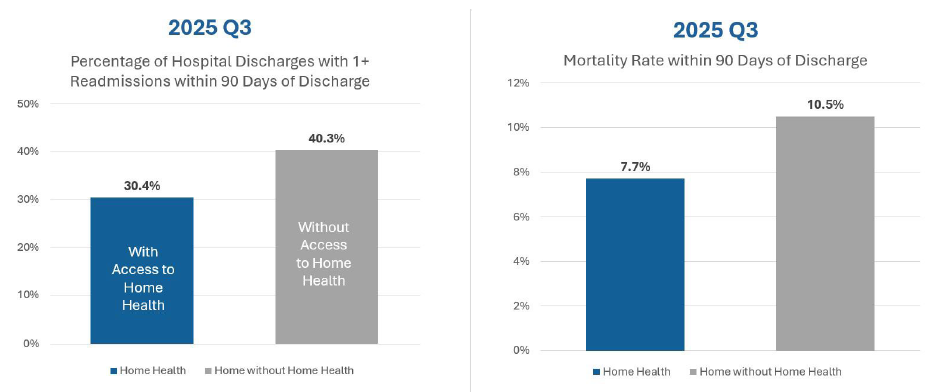
Source: CareJourney by Arcadia. Analysis of 2025 inpatient claim files.
In addition to improved outcomes, those beneficiaries utilizing HH also had a lower 90-day cost of care compared with referred patients who did not receive HH, even when including the payments for the HH episode(s) of care (see figure below).
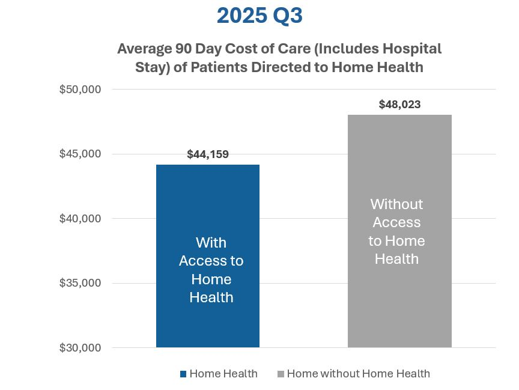
Source: CareJourney by Arcadia. Analysis of 2025 inpatient claim files.
The timeliness of receiving such care is crucial to these outcomes. For beneficiaries receiving HH, the emergency department visit rate, readmission rate and mortality rate all increase the longer a beneficiary must wait to initiate the care following discharge from the hospital.
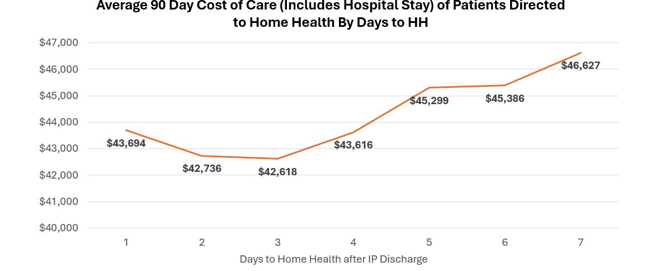
Source: CareJourney by Arcadia. Analysis of 2025 inpatient claim files.
HH agencies therefore remain essential to Medicare’s ability to help hospitalized beneficiaries return home safely, reduce the risk of post-discharge complications and avoid unnecessary, costly follow-up care.
Rising Costs of Care Continue to Strain Healthcare Providers
Healthcare providers, including hospitals and HH agencies, continue to face cost pressures. As detailed in our comments on the FY 2026 HH proposed rule, inflation has continuously pushed up labor, drug, supply and other core operating costs. A recent AHA report found that hospital expenses increased by 7.5% in 2025 alone.1 Much of this increase reflects labor costs, and an AHA analysis found that workforce costs rose by 5.6% in 2025.2 Further, advertised salaries for registered nurses have averaged 5.5% growth over the last two years — more than double the rate of inflation.3 While HH agencies are distinct from hospitals, they share many of the same costs, most notably labor costs. In addition to these market factors, the AHA has expressed concern that recent actions, such as changes to federal student loan limits that exclude nurses and other clinicians from enhanced borrowing limits, will exacerbate these workforce challenges.
Cost pressures also extend well beyond labor. Like other providers, HH agencies are increasingly caring for sicker and more complex patients, requiring additional and more costly drugs and supplies, and these costs also continue to climb. AHA analysis showed that in 2025, supply costs rose 9.9%, while drug costs rose a staggering 13.6%.4 In addition, a report from the Department of Health and Human Services (HHS) found that list prices for nearly 2,000 drugs increased by an average of 15.2% from 2017 through 2023 — outpacing general inflation.5 These cost challenges strain HH agencies, which must be prepared to provide treatment for a wide range of conditions and comorbidities.
Providers also are absorbing escalating administrative costs that are not reflected in payment updates. In particular, most MA plans require prior authorization for post-acute care, and providers must devote substantial time and resources to navigating these processes. The HHS Office of Inspector General found that many post-acute care prior authorization requests were denied inappropriately, requiring providers to expend significant resources appealing erroneous denials.6 Since plans do not reimburse these administrative expenses, providers must absorb them while caring for a growing share of MA patients.
These cost pressures are compounded by ongoing uncertainty around the potential for expanded tariffs across multiple sectors, including those that are vital to the healthcare supply chain. Despite efforts to strengthen domestic production, the U.S. healthcare system remains heavily reliant on international sources for many drugs, devices and other supplies needed to care for patients and protect healthcare workers. Tariffs — and potential retaliatory measures — could constrain access to these lifesaving items while also driving up input costs. As we described in previous feedback on tariffs related to pharmaceutical and medical devices, the AHA remains concerned they could increase the cost of delivering care.
Viewed collectively, these increases in staffing, drugs, and other essential supplies and services are placing significant strain across the healthcare continuum. They also are forcing providers to redirect resources that otherwise could be used to support patient care, adopt new technologies and make other efficiency-enhancing investments. In some cases, market basket increases are half, and sometimes less than half, of the cost increases observed by providers, which adds to the serious strain facing agencies. In addition, and as discussed further below, these same pressures amplify the negative impact of the productivity adjustment by limiting providers’ ability to fund the very investments that can drive operational efficiencies. Therefore, we urge CMS to focus on appropriately accounting for recent and future trends in inflationary pressures and cost increases in the HH payment update, which is essential to ensure that Medicare payments more accurately reflect the cost of providing care.
The Productivity Adjustment Exacerbates Insufficient Market Basket Updates
Under the Affordable Care Act, the HH payment update is reduced each year by a productivity factor equal to the 10-year moving average of changes in the annual economy-wide, private nonfarm business total factor productivity (TFP). The private nonfarm business TFP is intended to reflect gains from new technologies, economies of scale, business acumen, managerial skill and changes in production. As such, it effectively assumes that the healthcare field can achieve productivity gains comparable to those realized by private nonfarm businesses. However, as discussed in our comments last year, the healthcare field cannot mirror these gains. As a result, it is not an appropriate or reliable proxy for productivity. Therefore, we ask CMS to work with Congress to reduce the magnitude of the productivity adjustment.
A core problem is that the productivity construct embedded in the private nonfarm business TFP is a poor fit for measuring healthcare productivity. TFP outputs are measured based on the total quantity and prices of goods and services produced in private nonfarm businesses. In industries that sell tangible products, output can often be measured in relatively straightforward and standardized ways. Healthcare outputs, however, do not operate in the same manner. For example, “quantity,” such as volume of visits or procedures, is not necessarily an appropriate proxy for output; it may instead reflect the underlying disease burden in a community. More volume — i.e., more quantity — does not equate to higher productivity in the way it can for private nonfarm businesses.
Further, providers often cannot adjust prices per unit of service in response to changes in demand or quality in the way private nonfarm businesses can. Much of providers’ reimbursement is paid through fixed payment systems, such as the HH PPS, which limits their ability to alter prices. Similar constraints apply in the commercial market; providers do not unilaterally set their rates, and prices for commercially insured patients are established through negotiations that frequently lock in rates for multiple years. Accordingly, applying a TFP output framework based on quantity and prices — as experienced in the private sector — to providers is problematic because that output function does not translate to the hospital field.
In addition, providers also differ from many private nonfarm industries because services are inherently labor-intensive. As discussed in our comments referenced above, economic literature has long recognized that sustained productivity gains are difficult to achieve in labor-intensive service industries because labor cannot be scaled or automated in the same way as in other sectors. In this respect, providers are more comparable to fields such as education and social assistance, which tend to experience lower total factor productivity rates. For example, Bureau of Labor Statistics (BLS) data show rates ranging from -0.4 for educational services to -0.1 for social assistance, compared with 1.9 to 4.9 for industries such as mining, oil and gas, information, and professional services.
CMS itself has acknowledged that providers are not positioned to achieve productivity gains comparable to the broader economy over the long run. Specifically, CMS found that hospitals can achieve productivity gains equal to only one-third of those seen in the private nonfarm business sector.7 Although this was for hospitals, the same applies to HH agencies. Accordingly, using the private nonfarm business TFP to adjust the market basket is unsuitable.
Finally, we continue to find it especially troubling that the productivity adjustment appears to be applied only when it reduces Medicare payments. For example, in FY 2021, the 10-year moving average growth of the productivity factor forecasted was ‑0.1%. CMS acknowledged that subtracting a negative growth factor from the market basket would have increased it by 0.1 percentage points. However, the agency set the productivity factor at 0, stating that it is required to reduce — not increase — the market basket by changes in economy-wide productivity.8 Put simply, the agency uses the productivity factor only when it lowers Medicare spending.
The cumulative, compounding effect of these annual reductions — coupled with the asymmetric treatment of periods of declining economy-wide productivity — has widened the gap between payments and the cost of providing services, leaving providers increasingly underfunded. In light of this, the AHA continues to have serious concerns about the proposed productivity cut, particularly given the extraordinary pressures under which healthcare providers continue to operate.
Continued Budget Neutrality Adjustments Are Inappropriate and May Impede Access to Care
In last year’s final rule, CMS determined that it would not apply any budget neutrality adjustments for CYs 2023 and beyond related to implementation of the PDGM. Specifically, it stated that it does not anticipate needing further permanent adjustments in future years, explaining that behavior changes observed after 2022 are increasingly attributable to factors unrelated to PDGM implementation, including the implementation of OASIS-E, the national expansion of the Home Health Value-Based Purchasing Model, growing MA penetration and continued recalibration of case-mix weights. The AHA thanks CMS for this.
However, the agency is now proposing to continue its 3.0% temporary reduction to account for what it states were overpayments in CYs 2022 and prior. This payment reduction would be on top of approximately 15% in reductions the agency has already made to the base payment rate since 2020. The AHA urges CMS to suspend further PDGM budget neutrality reductions, including the proposed temporary reduction, and reevaluate the methodology used to calculate alleged overpayments under the new payment system. As detailed in prior years’ comment letters, the adjustments do not accurately account for shifts in care delivery and utilization under the new payment system nor accurately compare hypothetical payments under the old payment system to those under PDGM. The result is that CMS overestimates the difference in overall spending between the old and new payment systems, leading to much higher than appropriate budget neutrality adjustments. While this is partially addressed by the discontinuation of permanent, prospective adjustments, the continued application of temporary reductions, which may continue indefinitely to recoup the nearly $4 billion in supposed overpayments, will continue to strain HH providers.
In addition, the same rationale that led CMS to halt adjustments for CY 2023 and beyond also applies to 2022. Beginning in CY 2022, CMS annually recalibrated PDGM case-mix weights using the most current complete data available, which included CY 2020 claims data. Of course, these CY 2020 data were heavily affected by the COVID-19 public health emergency. Therefore, provider behavior that year was influenced by shifts in weights attributable to something other than the structure of PDGM itself. In addition, CMS recognized similar concerns elsewhere, including by maintaining CY 2022 low utilization payment adjustment thresholds to avoid distortions caused by pandemic-related changes in visit patterns. As such, CY 2022 data do not provide a reliable basis for measuring behavioral changes attributable to PDGM implementation.
The AHA therefore urges CMS not to make permanent or temporary adjustments based on CY 2022 data. Indeed, CMS should restore the permanent adjustment associated with CY 2022 to the 30-day payment rate for CY 2027 and recalculate any remaining temporary adjustment amounts for CYs 2020 and 2021 to account for amounts already collected through payment rates that were set too low.
The financial strain on HH agencies — which is due in part to prior budget neutrality reductions — is already contributing to clear signs of access problems for beneficiaries. For example, Medicare data indicate that beneficiaries have faced more difficulty accessing HH in recent years, with the percentage of patients referred to HH who did not access it within seven days of discharge increasing by 2.3% since 2023.
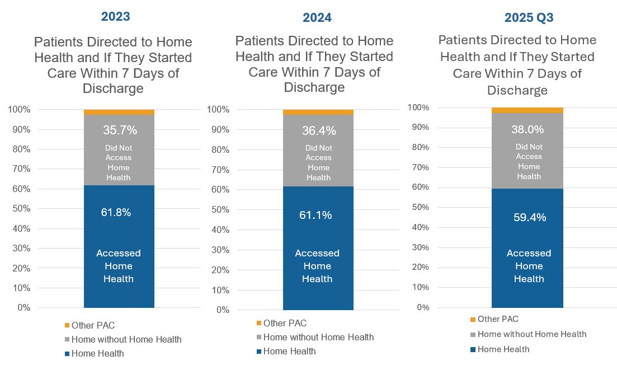
Source: CareJourney by Arcadia. Analysis of 2025 inpatient claim files.
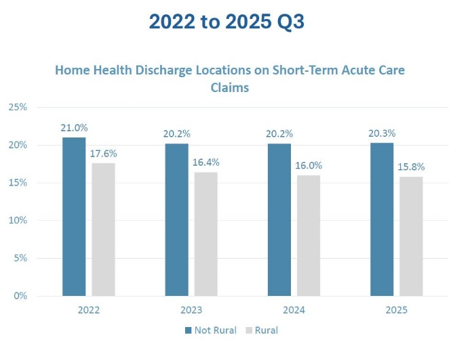
Access to care has become even more strained in rural areas. For example, data show that from 2022 to 2025, the percent of rural patients discharged to HH declined by 9.7%.
The Medicare Payment Advisory Commission (MedPAC) has conducted analysis likewise pointing to declining availability of HH services. Specifically, in its July 2026 data book, it reported that the number of fee-for-service (FFS) Medicare beneficiaries receiving HH services fell by 2.1%, while in-person visits declined by 3.2%. The strain on hospital-based HH agencies is particularly concerning, with MedPAC reporting that hospital-based HH agencies had a FFS Medicare margin of negative 15%.
These payment cuts have consequences beyond HH agencies. When HH agencies have less capacity, acute care hospitals face fewer viable options for discharging patients to appropriate post-acute care. As a result, hospitals may need to keep patients who are medically ready for discharge, increasing costs and reducing bed availability for other patients who need inpatient care. And indeed, AHA members continue to report growing challenges in securing HH placements for patients.
The challenge of discharging patients to post-acute care is magnified by the practices of some MA plans. While FFS Medicare does not require prior authorization for HH services, most MA plans do require such authorization. This is burdensome for the hospital, requiring staff time that could otherwise be dedicated to patient care, and often takes up to three days to receive a response. These delays further extend beneficiaries’ length of stay, compounding the issue of patient boarding. Indeed, a recent report from the University of Chicago found that MA beneficiaries have consistently longer hospital lengths of stay prior to discharge to post-acute care compared to FFS Medicare beneficiaries, and the length of stay has been rising for these patients. For discharges to HH specifically, the length of stay has increased by more than 20%.9 Therefore, as the AHA has previously requested, we respectfully urge CMS to address the harmful practices of MA plans that further restrict acute care hospital capacity and delay access to timely post-acute care.
Request for Information on HH-Specific Wage Index
CMS solicits comments on whether it should consider using alternative data sources, such as cost reports or BLS wage data, to construct a HH-specific wage index for potential use in future years. The AHA has conducted extensive policy work on the wage index. It is a difficult issue without a consensus solution. For example, using cost reports to construct a HH-specific wage index would be very burdensome, both to providers and to CMS itself. It also would create a system that is circular and self-perpetuating. Specifically, using only HH data in setting the wage index would mean that agencies could influence their own wage index values. This could lead to a problem where agencies with low wage indices may be unable to increase wages to become competitive in the labor market.
Policymakers also have considered using BLS data to calculate the wage index. The AHA and our members have examined these data closely and found that, while their collection and use may be significantly less burdensome, they have critical shortcomings. For example, BLS data exclude the cost of benefits. However, benefits are an important component of the wage index because the portion of total compensation attributable to benefits varies systematically. If benefits were excluded, the wage index would be understated in areas where benefits account for a greater portion of compensation; it would similarly be overstated in areas where they account for a lower portion. Therefore, any adjustments made to include benefit costs would have to be market-specific. In addition, if hospital-specific benefit information is to be added, it would have to be collected on CMS’ Medicare cost report. Yet doing so would add regulatory burden as well as some degree of circularity back into the system.
In addition, BLS data are derived from voluntary surveys and a sample of employers. Estimates using a sampling methodology like the BLS approach would be less reliable than using the entire universe of cost reports. CMS’ current process in calculating the inpatient PPS wage indices, and therefore presumably any new process for HH wage indices, allows for extensive public scrutiny of the data while the BLS approach does not. Unlike CMS’ public process for review and correction of cost report wage data, BLS has a strict confidentiality policy. Providers would thus be unable to verify the accuracy of the data.
BLS data also include data on the wages of healthcare workers employed in all industries. For example, healthcare sector data from hospitals, physician practices, skilled-nursing facilities, ambulatory surgical centers, home health agencies and hospices are all included. Yet, HH agencies differ from the universe of all employers in terms of the wage levels necessary to recruit and retain qualified employees, the percentage of compensation paid in benefits, the likelihood of unionization and other factors that affect compensation rates.
Finally, we urge CMS to consider whether it would need to create a system for reclassifications of HH agencies to a different labor market. Labor markets cannot realistically be defined as hard boundaries, and certain adjustments to the wage index may be necessary to accurately capture differences in labor costs across agencies. However, our members have expressed concern that the number of reclassifications and exceptions permitted under the current inpatient PPS is complex and confusing.
Provider Enrollment Provisions
The rule also includes proposals that would substantially change Medicare provider enrollment authorities not only for HH agencies, but also for hospitals, health systems and other Medicare providers and suppliers. The AHA is concerned that CMS included these proposals in an unrelated HH payment rule. Indeed, placing these far-reaching provider enrollment proposals in this HH proposed rule raises potential Administrative Procedures Act notice-and-comment concerns. See MCI Telecommunications Corp. v. FCC, 57 F.3d 1136, 1141–42 (D.C. Cir. 1995) (“Through its placement of the announcement concerning feature groups, the Commission has practiced just the sort of obscuration that the APA abjures.”); see also National Electrical Manufacturers Ass’n v. EPA, 99 F.3d 1170, 1174 n.3 (D.C. Cir. 1996) (“In MCI Telecommunications, the only warning given to long distance carriers of a proposed rule with far-reaching implications for their operations was contained in a single footnote to the background section of a notice directed to a different type of regulated entity, enhanced services providers. The court held that ‘an agency may not turn the provision of notice into a bureaucratic game of hide and seek’ and that the buried notice in question represented ‘just the sort of obscuration that the APA abjures.’” 57 F.3d at 1142.” (emphasis added)). Hospitals and health systems, as well as other types of providers, generally focus their regulatory review on rules directly affecting them. Because only a subset of providers provide HH services, this proposed rule likely has not received adequate review from the full range of affected regulated entities. CMS should use standalone rulemaking when proposing enrollment reforms of this broad scope. Standalone rulemaking would help ensure that the impacted providers are aware of the proposals and that the public comments are more representative of the views of the impacted providers.
Further, several of CMS’ proposals fail to directly target actual fraud risk and could result in significant enrollment consequences for non-fraudulent providers acting in good faith based only on technical errors, inadvertent mistakes, distant affiliations or conduct outside their control. Enrollment denials and revocations can have serious consequences, such as interference with patient access, operational disruptions and heavy liabilities.
Moreover, the AHA is concerned that the proposals to change and expand the definitions of “affiliation” and “managing employee” would impose significantly greater and overly broad reporting burdens on providers. For instance, the proposed definition of “managing employee,” which would be required for enrollment, disclosure of affiliations and reporting, includes an excessively broad list of positions. In hospitals and health systems, it would be unworkable to list every proposed managing employee for the hospital or service line, particularly because clinical leaders across departments and service lines experience frequent turnover, so each change would require another filing.
For these reasons and as detailed further below, the AHA urges CMS to finalize only those enrollment policies that are narrowly tailored, supported by objective standards, and accompanied by procedural safeguards that protect good faith providers and preserve beneficiary access to care.
Revocations and Denials of Enrollment
The AHA understands and appreciates CMS’ interest in strengthening payment safeguards. However, several proposed revisions to the revocation and denial regulations lack the objective criteria and proportionality necessary for fair application. As discussed below, CMS should retain meaningful guardrails, distinguish technical noncompliance from fraud or intentional misconduct, and ensure that providers have clear standards and a meaningful opportunity to respond before severe enrollment consequences are imposed.
Modifications to Existing Revocation Provisions
Abuse of Billing Privileges
CMS proposes to eliminate the four factors it must currently consider before revoking a provider’s enrollment for a “pattern or practice” of submitting noncompliant Medicare claims. These factors include (1) the provider’s adverse action history, (2) the share of noncompliant claims, (3) the reasons for noncompliance, and (4) any history of noncompliance. CMS says these factors have limited its ability to use this authority and are burdensome to apply. The proposal would only retain the standard of “pattern or practice” without further boundaries or specifics.
The AHA opposes eliminating this framework. The four factors that CMS proposes to eliminate provide important guardrails and require the agency to consider the totality of circumstances before taking the weighty step of sanctioning a provider. Retaining these guardrails is critical for hospitals and health systems, which submit large volumes of Medicare claims and may experience unintentional isolated errors or technical denials. Without defined factors, CMS could revoke enrollment based on an insignificant number of inadvertent, immaterial or corrected claims, while leaving providers with little basis to understand or challenge the determination.
The AHA recommends that CMS either retain the existing four-factor framework or replace it with clear, objective criteria that require CMS to:
- Evaluate alleged noncompliance in relation to the provider’s total Medicare claims volume.
- Distinguish isolated technical or billing errors from evidence of fraud, abuse or intentional misconduct.
- Consider the provider’s compliance history and good-faith corrective actions before revocation.
Moreover, we encourage CMS to define the circumstances that constitute a revocable “pattern or practice” so providers understand the standard and can meaningfully respond before enrollment is revoked.
False or Misleading Information
CMS proposes to allow revocation when a provider submits false or misleading information on any CMS or Medicare enrollment-related form, not just the provider enrollment application. It states that the provider’s intent in submitting the information is irrelevant; only the accuracy of the information matters.
The AHA supports accurate and truthful reporting. However, this proposal is too broad. Hospitals and health systems routinely submit numerous enrollment-related materials, including change-of-information filings, electronic funds transfer forms, revalidations and related documents. Under the proposal, even an inadvertent or corrected error could support revocation, regardless of intent, pattern, materiality or harm to beneficiaries or the Medicare program. This also gives the agency excessive discretion to decide which providers it will revoke since many are likely to submit unintentional mistakes.
Therefore, the AHA urges CMS to limit revocation under this provision to cases involving a demonstrable intent to mislead or a pattern of significant inaccuracies. Isolated errors that are inadvertent, insignificant or quickly corrected should not jeopardize a legitimate provider’s Medicare enrollment.
Extension of Revocation
CMS proposes that if any enrollment application submitted by a particular provider is denied, it could use this as the basis to revoke all other Medicare enrollments held by the same provider. CMS justifies this by stating that some denials involve behaviors so serious as to support revocation beyond a single enrollment.
The AHA urges CMS not to finalize this proposal. Hospitals and health systems often have multiple Medicare enrollments across various provider types, locations and service lines. A denial involving one new site or enrollment application — such as for missing paperwork, timing or operational readiness issues — should not put long-standing, compliant enrollments at risk elsewhere in the organization. What’s more, if a particular enrollee’s behavior was so serious as to warrant broader revocation, it is likely that CMS already has the available tools to address such serious behavior. As such, we recommend that CMS specifically apply any cross-enrollment revocation authority to cases involving fraud, significant misrepresentation or conduct that directly threatens beneficiary safety or Medicare program integrity. Further, before revoking other enrollments, CMS also should give the provider notice and a meaningful chance to respond.
Expansion and Reorganization of Retroactive Revocation Grounds
CMS proposes to make all Medicare enrollment revocations retroactive to the date the provider’s noncompliance started, rather than applying prospective effective dates as is currently permitted for certain revocations — typically 30 days after CMS or its contractor mails the notice to the provider.
The AHA opposes this retroactive revocation proposal. Retroactive revocation may be appropriate for fraud, intentional misconduct, or direct threats to patient safety or program integrity. However, it should not apply to technical or administrative mistakes, such as a missed reporting deadline, when there is no deliberate misconduct, beneficiary harm or risk to Medicare funds. Therefore, the AHA urges CMS to retain prospective effective dates for technical or administrative noncompliance and use retroactivity for serious misconduct or clear patient-safety risks. At minimum, CMS should create a safe harbor for providers that promptly correct noncompliance after it is discovered.
Claim Submissions After Revocation
CMS proposes to shorten the time period for which revoked providers may continue to submit Medicare claims from 60 days to 15 days. We are concerned that a 15-day window is too short for providers to identify and submit legitimate claims for services furnished to Medicare beneficiaries before the revocation date, particularly given intricate revenue processes, heavy administrative caseloads and external financial intermediaries. As such, the AHA urges CMS to maintain the current 60-day claims submission period. If CMS shortens the period, we ask that it allow no fewer than 30 days.
Additions of New Revocation Provisions
High-Risk Enrollments
CMS proposes a new revocation authority that would permit the agency to revoke a provider’s enrollment if CMS determines that the provider is located in a “limited geographic area” with an “excessive number of providers and suppliers,” creating an alleged high risk of fraud, waste or abuse. The AHA is concerned that this proposal is vague, overly broad and insufficiently tied to provider-specific conduct and threats because it uses provider density alone as evidence of fraud. For example, the proposal does not define “limited geographic area” or “excessive number,” leaving CMS with broad discretion to characterize ordinary provider concentration as suspect.
In addition, we have serious concerns that geographic location alone is not a sufficiently clear indicator of wrongdoing to justify revocation. It is commonplace for hospitals, health systems and other providers to locate in metropolitan and high-demand areas because that is where patients need care. Nevertheless, the proposal correctly notes that, if finalized, this proposal would permit revocation based on “not whether the provider or nearby providers have actually engaged in fraudulent conduct.” Put another way, providers who are entirely innocent but happen to locate near others would be subject to serious penalty. That is antithetical to basic principles of fairness.
The AHA also has serious concerns about the legal basis for this proposal. While the agency argues that this proposal “is akin to section 1866(j)(5) of the Act (codified in § 424.519),” those provisions actually weaken the agency’s case. Under those provisions, the affected provider at least has an affiliation with an entity that had previously been suspended or excluded. Here, revocation is permitted absent either affiliation or a prior adverse finding. Likewise, as the agency recognizes, § 424.519 is grounded in a specific statute giving broad authority based on affiliation alone. Here, Congress has not enacted any such statute that would allow revocation based solely on location. CMS is instead relying on its general legal authorities for this significant expansion of power. We do not believe existing law provides it with such authority. We therefore urge the agency to withdraw it.
If CMS does finalize this provision, the AHA urges it to define the terms “limited geographic area” and “excessive number” using objective, quantifiable criteria rooted in analysis of claims data. It should also require provider-specific evidence that the enrollment itself presents a high risk of fraud, waste or abuse.
Modifications to Existing Denial Reasons
Medicare Debt, Payment Suspension and Other Program Terminations/Suspensions
CMS proposes to greatly expand when it may deny a provider’s Medicare enrollment. Under current rules, CMS may deny enrollment based on issues tied to the provider itself, such as the provider’s own Medicare debt, payment suspensions from other programs involving the provider or its owners or managing employees, or terminations or suspensions from other programs involving the provider. However, CMS proposes to extend these denial rules to include not only owners and managing employees, but also any person or entity that has “any form of business or financial relationship” with the provider. The AHA is concerned that this proposed expansion is too broad and could extend to unreasonable circumstances.
Specifically, the proposal could cover many ordinary business relationships that have nothing to do with whether a provider should be allowed to participate in Medicare. For example, hospitals, health systems and other providers work with hundreds, and sometimes thousands, of vendors, contractors, consultants, staffing agencies and other organizations. Under the proposed language, a Medicare debt or payment suspension involving any one of these parties could be used to deny the provider’s Medicare enrollment application, change-of-information submission or revalidation. The AHA understands CMS’ concern that some outside parties can have significant influence over a provider. However, the phrase “any form of business or financial relationship” is so broad that it could include entities with little or no meaningful connection to the provider’s Medicare operations.
The proposal also would be difficult, if not impossible, for providers to administer. Providers may not always be aware of older Medicare debts or payment issues connected to a business partner, especially if the issue arose before an acquisition or from a relationship several steps removed from the provider. Yet, under the proposal, that information could still be used to deny enrollment. The AHA agrees that providers should conduct reasonable due diligence, particularly when financial debt is involved. But any such obligation should be based on a good-faith, reasonable standard rather than an expectation that providers can uncover every issue connected to every business relationship.
As such, the AHA urges CMS not to finalize this provision as proposed. However, if CMS nonetheless proceeds, we ask the agency to:
- Adopt a reasonable, good-faith standard to allow providers to conduct due diligence without being held accountable for disclosures that were not discovered despite their efforts to perform due diligence.
- Establish a standard that omits negligible or minor relationships or connections.
- Limit qualifying relationships to individuals or organizations with significant influence over the provider’s operations, management or Medicare billing.
- Prior to denial, give affected providers the ability to show that the relationship does not impact Medicare program integrity.
Additions of New Denial Reasons
Revocation or Denial in Same Suite
CMS proposes a new denial basis that would allow it to deny a provider’s enrollment if its practice location is in the same suite or office as another provider whose Medicare enrollment has been revoked or denied. The AHA opposes this proposal, which is overly broad. Hospitals and health systems routinely accommodate multiple provider types in the same facility, such as physician practices, outpatient clinics, ambulatory surgery centers and laboratory services, each of which may have separate Medicare enrollments from the hospital. While these providers usually have operational relationships with the hospital, such as through credentialing, privileging or contractual arrangements, simply sharing space does not suggest common ownership, control or risk of fraud. As such, it should not be the basis for denying enrollment. CMS’ assurance that it will use its discretion in applying this authority is not adequate.
Therefore, the AHA recommends that CMS:
- Require that a material linkage is involved, such as common ownership, management or operational control, rather than merely physical proximity.
- Include a presumption that denial should not apply if the enrolling provider has no ownership, management, financial or operational relationship with the revoked or denied provider.
Managing Employees
CMS proposes to expand the definition of “managing employee” to include medical directors, clinical directors, department heads, supervising physicians, nursing directors, alternate administrators and other clinical personnel who exercise operational or managerial control over a provider’s day-to-day operations. It describes the change as a clarification. It is not. Instead, this proposal would significantly expand the individuals that hospitals, health systems and other providers would be required to report on Medicare enrollment applications. Indeed, we are concerned that the revised definition would sweep in broad categories of clinical and operational leaders without clear thresholds for authority, responsibility or influence over Medicare program integrity. Many of these roles are substantially different from owners or senior executives who have overall control of the hospital or health system. Without objective criteria, providers will struggle to determine which individuals may trigger enrollment consequences such as denial, revocation or affiliation disclosures Moreover, this proposal would substantially increase the operational burden on hospitals. A single hospital may have many medical directors, nursing directors, department leaders, supervising physicians and clinical leaders, while a health system may have hundreds across campuses and service lines. Because these roles change frequently, the proposal could require never-ending enrollment updates and inappropriately increase the risk of unintended omissions and related enrollment consequences. As such, we urge CMS not to finalize this proposal.
If CMS nevertheless intends to advance this policy, AHA requests that it:
- Narrow the definition of “managing employee” for the purposes of enrollment-related consequences proposed in this rule (such as revocation, denial and affiliation disclosures) to include only individuals who have direct supervisory control over Medicare operations or program integrity.
- Provide a reasonable transition period and issue sub-regulatory guidance for applying the revised definition across organizations with complex structures.
- Clarify whether and how providers would be required to address retroactive reporting for individuals who would be newly covered by the revised definition of “managing employee.”
Affiliations
CMS’ current rules require that providers must disclose certain affiliations on the Medicare enrollment applications. Specifically, such reporting is required when the provider, an owner or managing employee has or had, within the previous five years, an affiliation with a current or former Medicare, Medicaid or Children’s Health Insurance Program provider that experienced a disclosable event.10 The current CMS definition for “affiliation” includes any of the following relationships:
- A 5% or greater direct or indirect ownership interest that an individual or entity has in another organization
- A general or limited partnership interest, regardless of the percentage, that an individual or entity has in another organization
- An interest in which an individual or entity exercises operational or managerial control over, or directly or indirectly conducts, the day-to-day operations of another organization (including sole proprietorships)
- An interest in which an individual is acting as an officer or director of a corporation
- Any reassignment relationship permitted under current regulations
As we have previously noted in comments to CMS, even this existing framework is overly broad and burdensome compared to any program integrity benefits that have arisen out of it. Yet, in this rule, the agency proposes to expand this framework even more by:
- Removing the five-year lookback period on disclosures of affiliations and expanding the definition to encompass any point in the provider’s enrollment, which would require an affiliation to be reported regardless of how long ago such an affiliation occurred or ended.
- Broadening the definition of affiliation to include owning an entity or managing employees or organizations of an entity that exercises operational or managerial control over another organization.
- Expanding the definition of affiliation to add a new category that would result in the inclusion of any marketing, business, fulfillment, financial, managerial or beneficiary relationships
The AHA has concerns with CMS’ proposed affiliation disclosure framework. Specifically, it would create broad, unclear and potentially unworkable disclosure obligations for hospitals and health systems by:
- Eliminating any time limit on affiliation disclosures, which would create an open-ended compliance burden. Hospitals and health systems often have long operating histories and complex, multi-tiered ownership and management structures. Over decades, thousands of individuals may have served in roles that could qualify as “managing employees” under CMS’ proposed expanded definition. Tracking and disclosing each person’s affiliations indefinitely would be extremely difficult, if not impossible, for many providers. Indeed, it is an infeasible and excessive burden to ask an organization for details reaching back to multiple decades of affiliation.
- Including an overly broad range of affiliations. For example, CMS’ proposal raises questions about whether every clinician who provides care to hospital patients could be viewed as having a “beneficiary relationship.” Without clearer guidance on which roles are covered, providers would face ongoing uncertainty about when disclosure obligations apply and whose information must be reported.
- Raising significant practical concerns about data availability. Large providers, particularly hospitals and health systems, may have no feasible way to identify affiliations involving former managing employees from many years ago, particularly when those individuals have long since left the organization. Requiring providers to disclose information they cannot reasonably know or obtain would create compliance risk without a corresponding Medicare program integrity benefit.
Therefore, the AHA urges CMS not to finalize its proposed changes to the affiliation framework. However, if it moves forward, we recommend that it:
- Limit the lookback period to only apply to the main provider and its current owners and managing employees, rather than extending it to all former managing employees and their historical affiliations.
- Adopt a “reasonableness standard” though rulemaking or sub-regulatory guidance that will consider providers’ good faith efforts to identify and disclose relevant information while at the same time acknowledging that there will be limitations to what a provider knows.
- Provide a safe harbor for good faith compliance, recognizing that providers cannot reasonably be expected to have complete records of all historical affiliations of all individuals who ever qualified as managing employees.
We appreciate your consideration of these issues. Please contact me if you have questions, or feel free to have a member of your team contact Jonathan Gold, AHA senior associate director for policy, at (202) 626-2368 or jgold@aha.org or, for the provider enrollment proposals, Roslyne Schulman, AHA director of policy, at (202) 626-2273 or rschulman@aha.org.
Sincerely,
/s/
Ashley Thompson
Senior Vice President
Public Policy Analysis and Development
__________
Notes
- AHA. (March 2026) The Cost of Caring: Challenges Facing America’s Hospitals as They Care for Patients in 2026. (https://www.aha.org/costsofcaring). [back^]
- Id. [back^]
- Id. [back^]
- Id. [back^]
- ASPE. (October 2023) Changes in the List Prices of Prescription Drugs, 2017-2023. https://aspe.hhs.gov/reports/changes-list-prices-prescription-drugs. [back^]
- HHS OIG. (April 2022) Some Medicare Advantage Organization Denials of Prior Authorization Requests Raise Concerns About Beneficiary Access to Medically Necessary Care. https://oig.hhs.gov/reports/all/2022/some-medicare-advantage-organization-denials [back^]
- Centers for Medicare and Medicaid Services. (February 2016) Hospital Multifactor Productivity: An Updated Presentation of Two Methodologies. https://www.cms.gov/Research-Statistics-Data-and-Systems/Statistics-Trends-and-Reports/ReportsTrustFunds/Downloads/ProductivityMemo2016.pdf. [back^]
- 85 Fed. Reg. 58,797. (Sept. 18, 2020). [back^]
- Coalition to Strengthen America’s Healthcare. (June 2025) Key Takeaways: NORC Report on Analysis of Post-Acute Care Discharges Among Medicare Beneficiaries, 2018 – 2022. https://strengthenhealthcare.org/key-takeaways-norc-report-on-analysis-of-post-acute-care-discharges-among-medicare-beneficiaries-2018-2022/%22 [back^]
- A disclosable event for Medicare provider enrollment is a past or current negative regulatory action or financial liability tied to an affiliate, owner or managing employee. Under 42 CFR § 424.519, providers must report affiliations with any entity that has experienced these specific events within the past five years. It specifically includes uncollected debt, payment suspensions, program exclusions or enrollment revocations/terminations. [back^]